Dear Readers,
I’m sorry I’ve been a flake, and that I’ve dropped the ball on posting. Life. I wish you happiness and fiber-y goodness at this time.
Your Absent Blogger,
Lydia
Dear Readers,
I’m sorry I’ve been a flake, and that I’ve dropped the ball on posting. Life. I wish you happiness and fiber-y goodness at this time.
Your Absent Blogger,
Lydia
Hey, it’s been 5 months since my last post, but who’s counting? And it’s my 6th blog-versary, so I guess the least I could do is post something quick in honor of this momentous occasion. Oh, and yes, as you can see I’ve changed the look of my blog.
Though blogging has not been at the forefront of my day-to-day life, knitting has been, and still remains my constant companion. I’ve worked on a few things: Maude by Julie Weisenberger (of Cocoknits), a hat from a Japanese knitting book Nordic Knitting: Seven Miraculous Techniques by Kirja Kongsbak, and #106 Silky V-Neck Sweater by Phoenix Bess. For various reasons, none of them are finished.
However, a friend needed a warm hat for her 2-year old daughter, and I was happy to oblige, and I actually finished it.
Here’s the finished object:


Details
Pattern: Blackberry Beret by Melody Lisa
Yarn: Lion Brand Martha Stewart Crafts Extra Soft Wool Blend
Needles: 4.0 mm (US 6)
This was an easy project and worth keeping; I added the little loop on the top using a 3-stitch I-cord. What is that little thing on the top of a beret called? There’s probably some technical word for it. My daughter was a great sport about modeling this, knowing that the hat was for someone else. I think she’s due an hat for that….
Current active projects are Eleanor Cowl by Audrey Knight (for me) and Simple. by Alicia Plummer (for my son).
When I went to Vogue Knitting LIVE Los Angeles last September, among my purchases from LIVE Marketplace was Cocoknits pattern Gisela (apologies that there are no posts about my Vogue Knitting LIVE LA adventure…yet). I was in the Habu Textiles booth and there was a sample of Gisela knit-up, so I bought the pattern and some Habu yarn on the spot. And then the whole thing cooled its heels in my closet until June, when I decided I’d like to have it to wear this summer.
Meanwhile, in listening to a Stash & Burn podcast this summer, hosts Jenny and Nicole talked about going to Stitches West and visiting the Cocoknits booth and trying on some really fun samples. I was intrigued, so I looked-up on Ravelry some of the things they saw in the Cocoknits booth at Stitches and made the connection that my Gisela and the stuff they saw were all part of Cocoknits (my mind is just too filled with daily life to make connections quickly these days). In looking on Ravelry I particularly liked Maude, but was hesitant to buy it because I wasn’t sure it would look all that good on me, so I added it to my Ravelry Favorites and thought nothing more about it.
At about the same I started Gisela, I looked at the Churchmouse Yarns & Teas class catalog for this summer and discovered that one of the same classes I’d tried to sign-up for at Vogue LIVE, but had been unable to get into was being offered: Julie Weisenberger’s European Finishing Techniques. So I signed-up. It would be perfect timing, I thought, since since I’d dropped the ball last spring and hadn’t signed my kids up for enough summer camps, taking a summer class might break things up for me a bit, and all the better that it would be in August, the month in which it hits every mom that, no matter how much you love your kids, school can’t start soon enough. I was ecstatic, both at being able to take this class, and at having the chance to take a little break to Bainbridge Island, where Churchmouse is located, even if only for a few hours. I set my sights on August.
So, I continued knitting along on Gisela, and all the while, it had still not occurred to me that I was knitting a Julie Weisenberger design. Yes, yes, even though it clearly said Julie Weisenberger and Cocoknits on the pattern: I tell you, I am just too preoccupied with nonsense these days! Not until the beginning of August rolled around, when I was beginning to wonder if I would get Gisela finished in time to wear this summer, was it that I looked at the pattern made the connection between Gisela, the patterns discussed on Stash & Burn, and the Julie Weisenberger class I’d registered for. That realization was like the heavens opening up and and hearing angels singing. I also wondered if I should have my head examined for not making the connection sooner. Suddenly I realized it would be great fun to wear my Gisela to class, and really set about knitting it in earnest.
Fast forward to two nights before the class: at about midnight I finished seaming Gisela, washed and blocked it. The next morning I put it on to wear to my husband’s boss’s family day at his beach house, and discovered that one sleeve was about 5 cm (2″) shorter than the other! So I spent to the whole ride to the beach house, missing the scenery on the way, picking-out the seams of the short sleeve, ripping-out the cap and knitting up the length. Midnight before the class, I finished re-seaming the sleeve, washed and blocked it again.
The morning of the class was no picnic, as it involved taking my kids to a birthday party in Bellevue on the Eastside, leaving them there with my husband and dashing off to the ferry in downtown Seattle. This would have been easily accomplished if not for the fact that the everything was against me that day. On State Route 520, the Evergreen Green Point Floating Bridge (yes, we really do have bridges that float here, maybe because it rains so much here—I’m kidding) was closed that weekend, so what would have been a quick hop across Lake Washington by toll bridge to Seattle to catch the ferry became a detour by way of the other floating bridge, the Murrow Floating Bridge (this is the bridge that infamously sank in 1990). Once in Seattle, and not living in Seattle proper anymore, I’d forgotten that Seattle is in the midst of its very own traffic nightmare at the waterfront where the ferry dock is because the decaying Alaskan Way Viaduct is being replaced with a tunnel, got caught-up in the mess and missed the last ferry to get to Bainbridge Island in time for class (I thought I’d be at the dock 45 minutes ahead of departure). By the time I was parked in line at the dock I still had a good hour before I could catch the next ferry and stew in my frustration knowing that I would now be an hour late for Julie’s class. My mood was not much alleviated with a brisk walk through downtown while the car sat parked in line, however I made my way to Watson Kennedy Fine Home and bought some locally made JonBoy Absinth & Black Salt Caramels, and I ate these back at the car with the gluten-free peach hand pie from Maninis I’d brought with me. Not healthy eating, but when you miss a ferry for a knitting class, who cares about healthy.
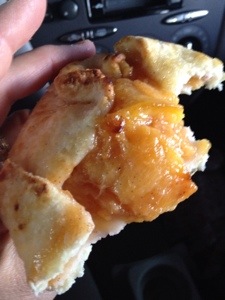
Maninis’ peach hand pie

Seattle
Having caught a later ferry, I arrived one hour late for a 3-hour class, but Julie graciously caught me up during break, and all was good. I’m really glad I didn’t give up just because I arrived late, as Julie is one of those rare people who not only enjoys her craft, but is an enthusiastic and generous instructor, and she had lots to share with us to help us improve our craft. Among the things she covered in the class was: long-tail cast on without running out of yarn, invisible seaming, decreasing and increasing without gaping stitches or stitches that stand-out or detract from the garment, a call for the end of “pick-up and knit x-number of sts” and replacing it with a simple, more realistic pick-up method.

invisible seaming
After class, I tried on probably half of her samples, and realized this woman is gifted with a creativity for designs that are often unique and yet feminine. In the end I bought the patterns for Maude and Veronika.
As for Gisela: I am surprised how much I like wearing it. I knew I’d like it, but I wasn’t too sure about wearing something with such an open stitch gauge, but I like the way it dresses-up a t-shirt on a summer day and gives a hint of warmth when in an air-conditioned environment. I’ve read that one or two people on Ravelry don’t like the way the collar doesn’t lie flat, but it doesn’t bother me, since I like the way it is, with it’s own character. It’s perfect for me.

Details
Pattern: Gisela, by Julie Weisenberger
Yarn: Habu Textiles, N-80 (silk-wrapped merino), colorway 3 (green merino with black silk thread)
Needles: 5.0 mm (US 8)


I confess, that despite my absence from blogging I have been knitting, and therefore, I also confess that I have not been blogging about it. Having said that, I think it’s time to do some catching-up.
From the depths of my knitting projects languishing in neglect, I present Bird’s Eye Shawl. Never reaching it’s originally intended size, and having become bored at the one-third point, I decided to call it “finished” and began casting-off last fall. The cast-off was so laborious, I didn’t finish it until April. Actually, I’m now glad that I didn’t make it bigger, because the rate of increases would have made the ends so long that I would not be able to wear it much. As it is, the ends are so long and tapering that I don’t know what to do with the ends; they get caught on things, trapped in car doors, pulled by small children. The resulting fabric is beautiful, and so soft, but I find I don’t wear it much because of the long ends. If I were to do it differently, I’d forgo the increases and make it into a rectangular wrap. Finished size: 200 cm (78 in.) x 85 cm (33 in.), blocked.

Details
Project: Bird’s Eye Shawl, by Sharon Miller
Yarn: Heirloom Knitting Merino Lace
Needles: 3.00 mm/US 2.5
Next to finish was Langston, in response to my daughter’s request, “Please knit me a sweater.” I added a few more rows to the bottom and cuffs, and a crocheted a little reinforcement to inside of the collar, to keep it slipping off of my 4-year old’s shoulders. Of course, by the time I finished it, she wasn’t able to wear it because the weather had turned too warm for wool sweaters on an active and vivacious 4-year old, but it should fit her fine this fall because it’s pretty roomy.

Details
Project: Langston, by Teresa Cole
Yarn: Knit Picks Gloss DK
Needles: 3.25 mm/US 3 & 3.75 mm/US 5
Then came Chinook Scarf, an end-of-the-year gift for my son’s first grade teacher. Fortunately, I started Chinook in April, and by most accounts of others on Ravelry who had knitted it before me, there was a good chance it would be done in less than a month, and it was. It is a narrow crescent-shaped scarf that started-out kind of fun and by about the middle began to drag on. The only thing that kept me going was that looming deadline of the last day of school in June, and still, it is a fun scarf, and I am toying with idea of making another one. It was tricky to get the I-cord edging just right because of it’s tendency to curl, and I found that if I kept the three stitches that comprise the I-cord quite loose, the curling wouldn’t be as pronounced. The other thing I realized, which is hard to see in many of the finished photos on Ravelry, is that the scarf is and arced crescent, and therefore to some degree the curling of the edge creates the arc.


Details
Project: Chinook Scarf, by Ali Green
Yarn: Claudia Hand Painted Yarns Fingering
Needles: 3.5 mm/US 4
For fun and relief after Chinook, I went onto Twig. I had this ball of fingering weight Shetland wool yarn loitering around in my stash, begging for a chance on stage, and I could leave it standing in the wings anymore, and I needed something fun and quick. I have no idea what brand it is nor could I trace it to any project I’d ever made, but I loved it’s peaty green color and was desirous of making a neck wrap of it. Based on the yarn weight, I approximated that I had about 150 yards of it, which gave me very few options, and then I saw Twig, and I knew that that was the one. Twig was fun to knit and, as you can tell from the pictures, very unusual to make. Great fun and I look forward to wearing it under a coat or sweater this fall.


Details
Project: Twig, by Grace Mcewen
Yarn: stashed fingering weight Shetland yarn
Elm Row came out of buying a skein of Cascade Yarns Alpaca Lace for a specific project and then deciding to use something else, so into the stash this went. I found Elm Row while sifting through Ravelry using the Advanced Pattern search (my favorite method of finding patterns) and knew that this would be perfect for Alpaca Lace. I loved knitting this, although I had to keep back-tracking and fixing mistakes because I was trying to knit it while watching movies. I fell in love with the yarn, and it’s so indescribably soft, I would love to have a whole bed made of it. I think this will probably be my new go-to scarf this fall and winter.

Details
Project:
Elm Row, by Anne Hanson
Yarn: Cascade Yarns Alpaca Lace
Needles: 3.25 mm/US 3
Since I didn’t use all of the skein of the Alpaca Lace for Elm Row, I just had to do something with as much of the remainder as I could. So I decided to look at Anne Hanson’s patterns and found Hellebores, which consists of a beret and wristlets, so I chose the wristlets. I like these wristlets! Just enough lace where it counts and ribbing where the cuffs are hidden by a coat sleeve. This pattern was easier to knit while watching movies, and it went along quite smoothly. I have to say that I am impressed with Anne Hanson’s patterns; she has such a sizable collection to choose from and they are well-written and interesting to knit.


Details
Project: Hellebores Wristlets, by Anne Hanson
Yarn: Cascade Yarns Alpaca Lace
Needles: 3.25 mm/US 3

March 1990-May 2012
The days of the past two weeks have blurred together, obscured by life’s busy-ness, and it’s unfortunate because I never thought the passing of my dear 22-year old cat, Olivia, would be so lost in daily life. I’ve discovered that having young children in my life causes things to way things to go that way. Between you and me and Olivia, I’ve often said that Olivia saved my life, and maybe to you that sounds too overblown, but it’s not too far from the truth.
I adopted a wee 6-week old kitten from the county animal rescue, thinking I’d saved her from the fate of being put to death, but really her entry into my life at that time gave me someone to come to home to when I was very lonely, my life lacked direction, and I didn’t know what potential my life held. She, and the second kitten I’d adopt one month later, Phinney, were little balls of delight to come home to after work. Doing temp work to pay bills, I found a roommate to help with the rent, and who tolerated the cats, and would eventually go on to her own home and adopt a cat or two, and who has ended-up a lifetime friend. My kitties saw me through poor choices in boyfriends, the death of my father to AIDS, my bout with thyroid cancer, marriage to my husband Alex, the addition of a stray cat who adopted us all and blended well with Olivia and Phinney, the arrival of our two children, and the passing of Phinney almost two years ago. Olivia loved the crinkle of paper, and it shocked to me to discover the loss of her hearing at age 5 due to an adverse reaction to a routine vaccine, but we weathered it and her super-loud deaf-kitty meowing for 17 years nonetheless.

In her younger days, she had a habit of sleeping in unladylike positions.
Over the last few years Olivia and Phinney didn’t get as much attention as they would have liked, although we cared for them, doted on them and loved them. For Olivia that meant that I overcame my fears and gave her weekly fluid injections at home, and she enjoyed the pleasure of going out on the enclosed deck to for fresh air, some kitty grass and a bowl of water. She became rather crotchety in her old age, but when your the equivalent of about 104 in human years, have kidney disease, can’t see well, and deaf, I think you have the right to have some attitude. Still, every evening she looked forward to our watching TV on the sofa next to her after the kids went to be, in fact she would wait for us, and if we didn’t come, she would come and demand our presence.

In her last two days it became apparent that she wasn’t doing well, wasn’t feeling well and that the end was near, and we all had the opportunity to spend a little time with her. But she is gone, and we miss her; her body was small, her presence was huge.

Asleep in her basket.
Here I am again, returned for a time from that mysterious world where blogging doesn’t occur called Life.
I have a few finished objects to report on, but one step at a time.

Most recently off the needles is Joyette and, as it’s name suggests, it was a joy to knit.
I needed a small shawl to fit under my jacket when I stand outside my son’s school waiting for dismissal in the cold, driving rain, and digging through Ravelry, I found this shawlette pattern. Lucky me, I just happened to have the right yarn for the job.

Looking rather serious. I must be thinking about the mountains of clothes to be washed, folded and put away.
The only hesitation I had in diving right in was because the pattern calls for a fair amount of crochet work at the end for the bottom edging, and I’m pretty rusty in that craft. However, my desire to start a new project that promised to fill a need was too great to ignore.
I loved this project, specifically the way it quickly grew and how the leaf stitch pattern took shape; it kept me on my toes and made it interesting.
From the depths of my stash, Sajama Alpaca, which I received as part of the gift exchange at the Seattle Knitters Guild Annual Holiday Party a few years back came to mind as perfect for this: two hanks of white and one blue. Luckily Joyette is knit from the bottom up, so I was able to use all of the white, reserving the blue for the crocheted edging along the bottom. Unfortunately, one skein wasn’t quite enough to complete all of the rows of the bottom edging, so I accomplished only half of the rows.

The edging that runs the length of the top of the shawl, was supposed to be a knitted picot bind-off, but I didn’t care for how that looked so I ripped it out, did a regular bind-off and opting instead for the very last row from the crochet edging (what would have been on the bottom of the shawl if I hadn’t run out of blue), slightly modified, for a more subtle finish (see photo below).


Details
Pattern: Joyette by Debbie Anne & Susan Ann
Yarn: Alpaca by Sajama in colors white and blue
Needles: 3.5 mm (US 4)
Crochet Hook: 3.75 mm (US F)
When it comes time for the monthly knitters guild meeting, my husband always checks with me earlier in the day if I plan on going, so he asked me recently via his iPhone. Unfortunately, iPhone’s Siri isn’t very familiar with the word “knitters”.

…bathed in white these days.

Thankfully, there is knitting to be worn for the occasion.

Details
Pattern: Whitfield Shorty by Anne Hanson
Yarn: Cascade 220, colorway 9454 (purple heather)
Needles: US 2.5 (3.0 mm) and US 4 (3.5 mm)
Wearer: 7 y.o. son

My son calls it his Rainbow Sweater, owing to the multi-color effect of the heathered colorway.

I wanted to make a simple wrap, because despite my attraction to lace shawls, particularly the triangular variety, I find they don’t suit me or my current lifestyle. In my ordinary suburban life, I am not going to be wandering the moors, and if I were to, I’d want something more substantial than a shawl, but especially, I have two young children to keep up with, so I don’t have time for something that keeps slipping off my shoulders. I’m finding the rectangular style works best for me, as it can fit under my coat or, as is more often the case, it can be wrapped around my neck as a scarf.

Kozue fits the bill, and I had some Jagger Spun in Ebony leftover from something that never came to be back in 1997, and they seemed like a perfect match. However, I messed-up (a common theme throughout the whole project, I’m afraid) early on, and realized that I would not have enough of the black to make a decent-sized Kozue, and I just kept going on as I pondered the futility of knitting something laceweight in stockinette stitch that may very well end-up as a blanket for my 3-year old daughter’s stuffed animals. Just kept knitting Kozue, but all the while trying to decide what to do. Clearly, finding anymore of the same dye lot was an absurd concept given two limitations: a) I bought the yarn in 1997, and b) I didn’t have the dye lot info., anyway. I went to Weaving Works in Seattle and looked at all the colorways in stock, and settled on Claret, a beautiful rich deep, deep pink, and added it on at one end of the wrap. Then I picked-up and started knitting it onto the other end, and that’s when it hit me: I was knitting a 1980s version of Kozue (you can see a photo of it in the previous post). The music from Psycho filled my head, you know that kind of shrieking music used in that movie, mixed with all the greatest hits from the ’80s. I was mortified. I didn’t even bother ripping it out, I cut the Claret off. Returned to Weaving Works, and this time settled for Indigo, a very muted blue, and definitely not to be confused with the cobalt blue of the ’80s. I was relieved that Indigo did the trick and I like the way the wrap turned-out, even if it is not the way I’d originally intended.

I added a band of Indigo to end of the shawl, and then cut off some of the beginning, picked-up stitches, and added Indigo, followed by the remainder of the black. Then, to cover the fact that adding a contrasting color was due to a mistake, I cut into a spot off-center of the middle of the piece, added Indigo there, followed by a few thin rows of black, followed by more Indigo, and then grafted it to the other half of the piece. Yes, it was a lot of work, but I kept telling myself that it would all work out fine, and it did. In fact, I think it’s my new everyday, go-to wrap.

Details
Pattern: Kozue by Kirsten Johnstone
Yarn: JaggerSpun Zephyr Wool-Silk 2/18 (Cone) in Ebony and Indigo
Needles: US 5 (3.75mm)
What a crazy few weeks it’s been. Where to start?
When I last posted, it was almost the end of August and Alex and I and the kids were off to the ocean for our summer vacation. Fast forward a few days with a rushed drive home from the ocean culminating in an emergency appendectomy (husband), in which we drove all the way back from our ocean trip straight to an hospital ER door. Follow that up with a last-minute, unplanned change of schools for our 7-year old (more on that some other time). Next was my trip to Los Angeles for Vogue Knitting LIVE! 2011 (more on that later, also). After that, I was home for 4 days before my husband and I flew to San Jose for a tour of the Tesla factory. Sometimes it’s just easier starting with the most recent thing first, so I’ll focus on the San Jose trip today, as well as some knitting..
So, Alex and I left the fall gloom of Seattle and landed in San Jose on a hot, sunny day—the sun felt so good. On our way to the hotel we happened upon a Japanese neighborhood festival and grabbed lunch. We had a hearty meal at Gombei.
 O
O
I had broiled mackerel—amazingly moist and buttery—with a side of cool tofu with green onion and bonito flakes, and Alex had soba noodles on a bed of ice cubes, which we found pleasantly refreshing on a hot day.

Before we left the festival, I bought a beautiful pair of Big Sur blue jade earrings.

Later that day, we left for the Tesla factory.
What is Tesla? I can’t possibly get all the facts right, but it’s a car company founded by Elon Musk, and is on the verge of changing the way we think about electric cars. Gone are the images of little puttering electric cars that drive about as fast as a golf cart and have a range that takes you not much further than the confines of your city.

The sedan Tesla, Model S, will seat 7 people, will be completely electric, have enough charge to go up to 300 miles, and will be able to accelerate from 0 to 60 in 5.6 seconds. The current Tesla car, the Roadster, is a two-seat model, has a range of 245 miles, and accelerates 0 to 60 in 3.7 seconds.
 Elon Musk, addressing the crowd.
It was quite an event, and we were there with a couple thousand future Model S owners for the tour and a ride in the Model S. The final version of the Model S has not been made yet and will not be available until 12 months from now, so we rode in a beta model. The test ride was fast, and demonstrated it maneuverability, low center of gravity (due to the lithium batteries on the bottom of the chassis), and responsive acceleration by taking it up to 70 in a short closed track. It was fun.

Knitting. I been using-up my stash of Zephyr 2/18 in black, making Kozue, and I thought I’d have enough for it, but I don’t. Having bought the yarn about 10 years ago, I couldn’t possibly match dye lots, so I bought some in a different shade, Claret. I decided that it would be best to add bands of Claret in various placed throughout the shawl. I’ve put a sizable band near the end of it, and now I’ll add a thinner band to the beginning by cutting into the earlier rows and picking-up stitches. Why do I always have to do things the hard way?

I’m trying to roll with the fact that final Kozue isn’t going to look the way I’d hoped it would, and find that inner easy-going me that never was, and love the new look.
 domesticshorthair